Monday, September 29, 2008

The First Day of Electricity

Experiment 1: Exploring the Nature of Electrical Interactions
This experiment posed two hypothesis:
1. The interaction between objects that have been rubbed is due to a property of matter that we will call charge. There are two types of electrical charge that we will call, for the sake of convenience, positive charge and negative charge.
2. Charge moves readily on certain materials, known as conductors, and not on others, known as insulators. In general, metals are good conductors, while glass, rubber, and plastic tend to be insulators.

To test hypothesis 1 we did an experiment using scotch tape 
First we took two pieces of tape and attached them to the table. After pulling the two pieces off and putting them next to each other, with the non-sticky side of the tape facing each other, we noticed that the tape would repel from each other. Also, as the distance between the tape became smaller, the repulsion seemed to go up.

Then, we put two pieces of tape on the table and labeled them "B" for bottom and another two pieces, labeled "T" for top, over B. When we peeled B off of the table and T off of B we found that the two Bs and the two Ts were repelled by each other, but a T and a B were attracted to each other.

From these experiments we concluded that the hypothesis was true because for the Bs, as well as the Ts, the procedure to charge them was the same, and so they must have the same charge. However, the procedure to charge B and to charge T was different and so we got a different result when putting B and T close together. If there were more than two charges there would have been more than two results for the two procedures of charging B and T

Experiment 2: Charging Styrofoam Balls with Rods
This experiment was used to give us more experience studying the interactions between charged objects 

First we charged the styrofoam balls by touching them to a plastic rod, that had been charged by rubbing it against fur. When we brought the plastic rod near the balls a second time the balls were repelled by the rod because both the rod and the styrofoam balls had the same charge.

Then we charged a glass "rod" with polyester, giving it a positive charge. When the glass rod was brought close to the styrofoam balls the balls were attracted to the glass because the balls were still negatively charged from the plastic rod.

To test hypothesis 2 we did an experiment using induction to charge objects
Experiment 3: Insulators, Conductors, and Induction

First, we charged a plastic rod with fur and brought it close to an uncharged styrofoam ball. The ball and the rod had no interaction. We then switched the styrofoam ball for another metal coated styrofoam ball, which was also uncharged; when the charged plastic rod was brought close to the uncharged metal coated ball the ball became attracted to the rod. We tried this same process with a metal sphere that was uncharged and had the same result.

These results lead us to the conclusion that the styrofoam is an "insulator" while the metal is a "conductor." The metal, having the ability to move or spread charge more easily, was able to be charged by induction from the rod. So the neutral charge in the metal, equal positive and equal negative, was able to move, or be polarized when the rod came near it. So the negative charge of the rod caused the positive charge in the metal to "move" to the side closest to the rod. This is why the metal objects were attracted to the rod even though they had not been charged by touching the rod to them. The styrofoam does not have this ability, and therefore that is why there was no reaction between the uncharged styrofoam and the charged rod.

I don't remember exactly when but we did define:

1. electric charge: the amount of matter that interacts electrically in an object
- an intrinsic property that defines how it interacts electrically
- Mason made the point that charge is to electricity and magnetism what mass is to forces and basically everything learned in 4A

 2. coulomb: the basic SI unit for charge which is denoted by C.

Because of the humidity in the air we could not perform the experiment for Coulomb's Law, so instead we used a physics program to examine the effect of distance on the force between two point charges. 

In the program we set up two point charges with the same charge and like signs, which would cause them to repel from each other. We then had the program give us a graph of the acceleration for each point charge because the force by, Newton's Second Law, is proportional to the acceleration times a proportionality constant, which is mass.
When then examined the graphs for different situations:
We noticed that when we doubled the magnitude of the charge on one particle the the force on both particles becomes double. We therefore concluded that the force is proportional to the product of the charges. 
We also noticed that when we increased the distance between the two, the force became less and the graphs for the acceleration, and therefore the force, became 1/(x^2). From this we concluded that the force is proportional to 1/(distance^2).
Therefore, Coulomb's Law is:

F = k(q1q2)/(r^2)

Where k is the proportionality constant = 9.0E9 (N x m^2)/C^2
and r is the  between the point charges

We then looked at Coulomb's Law as a vector quantity by examining the direction of the unit vector. 
The unit vector is a vector that has a magnitude of one and gives the direction of the force. In the activity two point charges q1 and q2 are at a distance d from each other. We then examined how the direction of the unit vector changes, the direction of the force, changes when the signs of q1 and q2 are changed. 
-x   <------------q1----------------------q2---------------> +x

When q1 is positive and q2 is negative, when the charges are opposite:
 the unit vector of q1, which denotes the direction of the F2 on 1 ,points in the -x direction, while the unit vector of q2, which denotes the direction of F1 on 2 points in the +x direction

                    F2 on 1 <----------q1                                  q2--------------> F1 on 2

When both charges are positive or both are negative, they have like charges:
the unit vector of q1 points in the +x direction, while the unit vector of q2 points in the -x direction

                     q1------------> F2 on 1                F1 on 2<--------------q2

BUT, forces can move along their line of action so we can redraw the last picture like this:

                  F1 on 2<------------q1                                       q2------------->F2 on 1

 Therefore, no matter what the charge combination, like or opposite, the unit vectors will always point AWAY from two point charges.

We then tested our skills by calculating the force on two point charges by using trig and then by using unit vectors and discovered that unit vectors are easier.

bam <----there Joy are you happy?  


P.S. Joy smells; Dante rocks


Saturday, September 20, 2008

Special BLOG # 1: Saturday review section

1st.....this is the practice exam....

http://docs.google.com/View?docid=dhtfdzv3_1f9x8jgjp

getting into subject...

Chapter 17

Thermal expansion and thermal stress

delta means changing

Linear expansion(1D):

delta L = alpha * Lo * delta T
@where L is length, Lo is the initial length and T for temperture


Volume(3D):

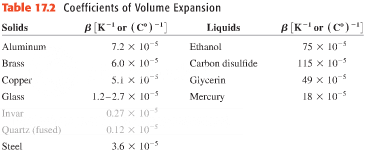
delta V = beta * Vo * delta T
@where V is volume, Vo is the initial volume and T for temperture

(there's also a equation for 2D....just change the V or L to A(area) and multiply alpha by 2)

here's the alpha and beta from the book....


Thermal conductivity

Q = (k*A*delta T) / L
@ where k = specific Heat, A = cross-section Area, T= temperture, L = length

so...how does this work...

since Q1 = Q2 (if, they conduct together)

so we can set up like....(taking Copper & Aluminum as example.....)

QCu = QAl

then, [400*A*(Tf - To)]/LCu = [240*A*(Tf - To)]/LAl

then we can find the common variable Tf

Phase Change

Temperature remains CONSTANT until change of phase is complete .remember this....very important....

Lf = Heat of Fusion

Lf => 80(cal/gram) = 3.35 x 10^5 (J/kg)

Lv= Heat of Evaoiration

Lv=> 540(cal/gram) = 2.26 x 10^6 (J/kg)

and remember!!!!!! Qgain + Qlost =0

example is in here....http://physics4b.blogspot.com/2008/09/third-daysighlong-weekend-no-more.html

Chapter 18

Ideal Gas Law

PV = nrT
for P=pressure(pa), V=vloume(m^3), n=# of moles(mol), r = 8.3145 , T=temperture

or

PV = NkBT
for P=pressure(pa), V=vloume(m^3), N=# of Atoms, kB = 1.38x 10^-23 , T=temperture

they are same equation....only different is dealing with mol or atom....differ by an Avocado's number....(i know...just think it as a typo)

oh......by the way.... 1 atm = 1.01 x 10^5 Pa....always convert it to Pa


Vrms = sqrt( [3*kB*T]/m )
@ where sqrt() = square root, kB = 1.38 * 10^-23, m = mass of gas(element) atom

or

Vrms = sqrt( [3*R*T]/M )
@ where sqrt() = square root, R= 8.314, M = molar mass of the gas(element)

Ktr = (3/2)*n*R*T

Heat Capacities

Cv = (3/2) * R (monatomic gas )

Cv = (5/2)* R (diatomis gas )

Cv = 3R (monatomic solid)


Chapter 19 & 20

General equation for all

Ein = Q - W

Ein = internal energy, Q=heat, W=work

isochoric

V = const

since there is no changing Volume, there W= P * delta V will just simply equal to 0.

and then the general will be:

Ein = (m*Cv* delta T ) - 0

therefore,

Ein = (m*Cv* delta T )

and we can use this equation for all thermodynamic process, as long as it's Ideal Gas.

(cuz Ein will not change...so this equation will apply everywhere)


isobaric

P = const

since P =const, there is both Q and W.

Q = m*Cp*delta T

W = P * delta V

apply them back to the general equation

Ein = Q - W ,we will get

Ein = m*Cp*delta T - P * delta V

furthermore, apply the Ein we got in the previous part we will get

(m*Cv* delta T ) = (m*Cp*delta T) - (P * delta V)

by this we can calculate everything......for isobaric

isothermal

T = const

since Ein = 0 , therefore

Q + W = 0

(reason why I dont do Q = W is because there will be a sign problem. is you do Q + W , then since one is positive and the other one is negative. we dont have to worry about sign. )

and W in isothermal is

Q = W = nRT * ln Vf / Vo

= P1V1 * ln Vf / Vo

Adiabatic

it means no heat

so, Ein = -W

W = n*Cv*(To -Tf) Note: yes, it's To - Tf(since it can be both release or absorb heat....well..u know what i'm trying to say...)

and for adiabatic....there's something more than this equation... sometimes we need to find P, or V, or T ourself.....in that case....we need to use these equations....

T1V1^(gamma - 1) = T2V2^(gamma-1)

P1V1^(gamma) = T2V2^(gamma)


Buoyang force

1st, buoyang force is a upward force that particle will excert by fluid(or gas).

cutting into subject, the hot balloon. we can simply draw a force diagram.

| FB

|

B

|

| mg


in which FB is the buoyang force upward, and mg is the weight downward.

in the general difinition, B= D * V* g .

B=buoyang force, D=density, V=volume and g = gravity


F = P/A, which also tells that P = FA. P=pressure, F=force, A=area

then we can get the presure excert by buoyang force is simply P = D*g*h (since V/A = height...)

so for the hot balloon, for it to float(upward force = downward force), the force FB = mg. then we can derive many more equation and so on....

oh...remember buoyang force is everywhere!!! even for the bottom of the hot balloon.

(end)


Thursday, September 18, 2008

Heat Engines, pV-Diagrams, & Adiabatic Changes

Today was Wednesday.... QuizDay!!!! Yay!!

Our quiz focused on analyzing a pV-diagram of a Heat Engine.
  • Find the work done in the isobaric process from A to B (part 1).
In an isobaric (constant pressure) process, the work done by the system is given by this equation:
W=p(V_2 - V_1)
The work can also be found by finding the area under the curve (or in this case, line).
Since the change in volume was a positive one (i.e. V_2 > V_1) the work was positive.
  • Find the work done in the isochoric process from B to C (part 2).
In an isochoric (constant volume) process, there is no work done. This is because Work=Force*Distance, and since the distance is 0, so is the work.
This is also apparent when you look at the graph. Since this portion has constant volume, the graph shows a vertical line, with the area under the line = 0. Therefore the Work = 0.
  • Find the work done in the isobaric process from C to D (part 3).
We found work using the same formula we used in part 1. Except for in part 3, V_f <>
  • Find the work done in the isochoric process from D to C (part 4).
This constant volume segment (same as part 2) of the process also produced no work.
  • Find the net work done in the whole system.
The trick to this part was making sure the signs were correct in terms of positive and negative work being done.
Remember, in thermodynamics:
Work is (+) when work is done by the system against its surroundings (the system expands), and energy is leaving the system
Work is (-) when work is done on the gas by its surroundings (during compression of a gas), and energy is entering the system.

After the quiz we gathered in groups of three based on alphabetized elements from the periodic table. We then observed a heat engine first-hand. This was a cylinder and piston (both made of glass) connected by a tube (to allow air flow) to a metal spherical ball (metal in general is an excellent heat conductor).
First the ball was placed in a cold reservoir (an ice box) so the air inside the chamber and the tube cooled, reducing the pressure. Then the ball was placed in a large beaker of hot water. We watched in amazement as the glass piston was mysteriously moved from it's initial position as the volume inside the chamber expanded. This proved to us that work was done by the system due to the changing temperature and volume.

After the experiment, we analyzed a pV-diagram with a cycle that was similar, if not identical to the one on the quiz. We determined which part of the cycle is work done on the gas and by the gas. We also determined which parts of the cycle was heat transferred to the gas and from the gas.
Then we used the equation E_int = (3/2)pV to calculate the internal energy at each of the four points and then the change in internal energy for each part of the cycle. We then calculated the work done using the equation W=p(V_2-V_1) for the isobaric portions and 0 work for the isochoric portions. From this we calculated Q (heat energy) using the equation Q = (change in)E_int + W.

In the next activity, we derived several relationships for adiabatic expansions.

First, we used pV=nRT and the relationship C_p-C_v=R. With some algebraic manipulation, we showed 

n(delta)T= [P(delta)V+V(delta)P] /C_p - C_v

Then we used the fact that Q=0 in an adiabatic expansion and the equation (delta)Eint=C_vn(delta)T to show
n(delta)T=-P(delta)v/C_v

We then used these two new equations to show that

(delta)P/P+(C_p/C_v)((delta)V/V)=0

After this, we showed that the limit of very small changes could be integrated into this equation:

ln(P_i)+(C_p/C_v)ln(V_i)=ln(P_f)+(C_p/C_v)*ln(V_f)

With some more mathematical manipulations, we showed that

(P_f)*(V_f)^(gamma)=(P_i)(V_i)^(gamma)

Then we used this in conjuction with the ideal gas lawto show that

(T_f)(V_f)^(gamma - 1)=(T_i)(V_i)^(gamma - 1)

The last derivation of the day gave us the Work in an Adiabatic Expansion:

W_adiabatic={[(P_i)(V_i)^(gamma)][(V_f)^(1 - gamma) - (V_i)^(1 - gamma)]/(1 - gamma)


Then we used this equation to calculate the work done in an adiabatic expansion given the initial and final values of pressure and volumes.

BAM!!!

Wednesday, September 17, 2008

Who loves fun and fire? Everyone, I can't think of a single person who doesn't. So what better than throwing fire around in a plastic bottle? Our day started with a little experiment where we took a lit candle, contained it within the sealed environment of a plastic bottle, and dropped it. The more science-y term for it (that NASA used) would be "experimentally observing combustion under micro-gravity."

We found that flames in a contained environment in a gravity-free inertial frame of reference would burn less brightly, and form a spherical "flame." This was due to the fact that air particles heated up would fail to "rise" and allow cold air to reach the flame. Oxygen would reach the flame at a greatly reduced rate, forcing the combustion reaction process to occur more slowly. As a direct effect, the flame would stay lit a lot longer than it would have if it burned normally.

This led into the main topic of the day. Heat engines! Engines that use heat to perform work, specifically, with regards to ideal gases.

First, the question was posed: Does the ideal gas law tell all? It was decided that it could be used to find certain values, provided some values stayed the same. Since we wanted to discuss the idea of work and internal energy as well, we came up with the first two types of processes: the isothermal, and adiabatic processes. These are defined where the former is a process where the temperature stays constant throughout the process, and in the second, the process is properly insulated from the surroundings as to not exchange any energy with it.

In order to relate gases and work or energy, we combined the ideal gas laws and the first law of thermal dynamics.

E= Q - W = Q - Integral(PdV)
Where:
E = internal energy
Q = heat energy exchange
W = energy used for work
P = pressure
dV = change in pressure.

Now, the very definition of isothermal, a process where the temperature remains the same, means that the change in the gas' internal energy is 0. The energy remains the same.

0 = Q - W

With a little bit of mathematical leg work, minor substitution, we arrive at the isothermal equation of:

Q = nRTln(V)

This gives us the amount of energy lost to the environment in order to maintain a constant temperature, when we are given a volume, temperature, and the number of mols.

So, what if we wanted to find out what happens when we don't lose any energy to the surroundings? Then how much volume would change with each bit of temperature change?

Using some more mathematical legwork, we arrive at the equation:

Tf^(3/2)*Vf = Ti^(3/2)*Vi

This was found when we integrated the equation

(3/2) dT/T = dV/V

That equation was found by substituting N*k_B for pressure in the equation

(3/2)N*k_B*dT = -PdV

The important thing is in bold!

In order to simulate and predict an adiabatic process, we used the ever amusing fire syringe. Measuring the dimensions of the tube originally, and then in its compressed state, we predicted the temperature of the compressed gas to rise well above 3000 kelvin. More than enough to burn paper, which we easily see happen. Cool! Physics works!

Next, we dealt with the very idea of an "engine." Something that can repeatedly take heat from a process and turn it into work. In order to demonstrate this, we use large rubber bands, heat guns, and heavy lifting. I'm sure you all remember what happened.

However, we discovered a new factor in doing work with heat. Waste energy. Of course not 100% of all energy gone into making the heat can be converted to work, so we used the experiment to practice the idea of efficiency. How efficient was the rubber band at taking 1500watts of energy and using it to lift a 1kg weight? Not very. Not very at all.

But beside that minor disappointment, we ended up with the equation

n = 1 - (Q_C/Q_H)

where efficiency is equal to 1 minus the amount of waste heat divided by the used heat. Nifty.

After this, we moved onto a rapid fire discussion of the other variables that were involved in heat engines. We quickly reviewed the equations for adiabatic and isothermal processes, but then we moved onto isochoric and isobaric processes. Constant volume, and constant pressure accordingly. Something important to remember: in an isochoric process, we can't do any work! The gas must not be allowed to expand! To lift cylinders, or lower pistons, or anything like that. Yea.

After a very challenging problem which involved various equations (the trick is to know WHICH variable is constant!), we managed to find how much energy it took to pump a bunch of water vertically into a tank sitting somewhere above a lake, without letting any of the air out. Then, prepared to tackle thermodynamic physics, we went home and all logged into masteringPhysics to finish our homework and eagerly await Wednesday. Didn't we. DIDN'T WE?!


Monday, September 15, 2008

SI volunteer until the first exam!

Great news!

Edward Sacca has volunteered to SI for the class until the 25th when his classes start at UCSD. He is living proof that some students actually pass physics and TRANSFER!

He will be attending some classes and holding homework help sessions BEFORE class each day. STARTING WEDNESDAY (From 10 am to noon) in the student study room. Here is a link to his facebook page:
http://www.new.facebook.com/home.php#/profile.php?id=581708337&ref=name

Here are the notes for class today.
http://docs.google.com/Doc?id=d3w6sww_437d2hr8dc8

Good luck!
mmason

Sunday, September 14, 2008

Chapter 18 is finished!

This class was a little different than the previous meetings. It was heavy on lecture, with fewer experiments. We did, however, participate in the largest scale (and most interesting) experiment, to date.

The class began with a quiz. This quiz was based on one of the previous homework problems, in which the temperature of compressed air within a cylinder of a car’s engine was determined. The trick to solving this problem lies within the understanding of gauge pressure versus atmospheric pressure, which was clarified in the previous homework assignment. This should reaffirm just how important the homework assignments are.

Once the quizzes were collected, the solutions given, and our groups divided according to alphabetically listed Olympic Sports, we dove into the topic of the day: Kinetic Theory and the Definition of Temperature.

We learned that the temperature of a gas is defined as the Kinetic Energy of its molecules. By applying this information to our previous equation:
PV = (2/3) · N ·

we can determine that:
= (3/2) · kBT

We went on to discuss that molecules store internal energy through vibration and rotation, and that we should ignore gravitational and electrical potential energies for now. This leaves us with:
Eint = N ·

Through substitution with the Kinetic Energy equation, and after solving for T, we determined that:
T = [2/(3kB)] · [ Eint /N]

At this time, Professor Mason began an experiment to relate the temperature of a gas to its volume and density. He had us use heat guns to begin heating the air inside a large balloon. After a few minutes, we realized that we should have conducted this experiment outside, as the balloon nearly touched the ceiling and floor simultaneously. Professor Mason decided to move the experiment outside, but not before we were able to see the balloon was definitely floating, with no outside assistance. Once we moved the balloon outside, we were unable to duplicate these results. It seemed as though a hole developed in the top of the balloon, allowing the hot air to escape faster than it could be added.

When we returned to the classroom, Professor Mason described a high altitude balloon that he had launched with the help of previous Physics students. He went on to describe how some of the instruments had failed at high altitudes, since the cold temperature prevented the batteries from supplying sufficient voltage to these instruments. This seems like a topic that will be brought up again later in the course when we discuss electricity. There was also a brief mention of Steve Fossett, who was an explorer made famous by circumnavigating the planet in a hot air balloon. http://en.wikipedia.org/wiki/Steve_Fossett

The balloon experiment led to the discussion of buoyant forces. As the air is heated and the volume expands, the mass remains constant. Therefore, the buoyant force on the balloon is constant.

Then our groups were instructed to go back on the Active Physics website. We used an applet on this website to answer the first 5 questions of a handout that we were given. The purpose of this exercise was to understand the Root-Mean-Square Speed (Vrms) of atoms, relative to temperature, and how it differs from the average speed.

We were shown that the equation:
PV = nRT

only works for ideal gases, and that the derived equation, known as Van Der Waals Equation of State is actually:
[P + (a) · (n/V)^2] · (V – nb) = nRT

There is a chart of Van Der Waals constants that can be used to determine the “a” and “b” values for this equation.

As time was running out, we were shown that the previously established Kinetic Theory of Gases:
KEaverage = (3/2) · kT

only applies to monatomic molecules, such as Helium, and that rigid diatomic molecules use the equation:
U = N · KEaverage = (5/2) · NkT

While vibrating diatomic molecules use the equation:
U = N · KEaverage = (7/2) · NkT

Professor Mason quickly flashed the following molecular velocity equations on the screen:
Vaverage = (8/pi)^(1/2) · (kT/m)^(1/2)
Vrms = (3)^(1/2) · (kT/m)^(1/2)
Vprobable = (2)^(1/2) · (kT/m)^(1/2)

At the conclusion of class, we had completed Chapter 18 (sections 18.3, 18.4, and 18.5) and Professor Mason emphatically commanded us to READ THE BOOK!

Monday, September 8, 2008

Ideal Gas Laws

Today, we began with yet another neat presentation. We had a small beaker of water on the ground, and suspended in the water was long tube filled with water and stoppered at the other end. The question was once the stopper was removed, what would the water do and why?

We did lots of stuff today, so I'll break it into the experiemnts we did and what we learned (or should've.)

Presentation/Opening Question

We had a small beaker of water on the ground, and suspended in the water was long tube filled with water and stoppered at the other end. The tube was suspended in the water using a scale, which in addition to holding it up, measured the force (weight) the tube and water exerted on it. The question was once the stopper was removed, what would the scale read: heavier, lighter, the same, and why? After a suspensful 5 seconds while Prof. Mason pulled out the stopper, the water came gushing out and the scale.....showed it was less. Because the tube was filled with water and then suspended into the beaker of water, the water inside the stoppered tube was actually at a lower pressure than the atmosphere around it. When the stopper was removed, the pressure inside the tube equalized and the water came out. Initially, the tube and water were supported by the water in the beaker because of the pressure differential.

First project: Straw tube thing

In this experiment, we attached a straw to each end of a rubber tube and then filled it with a little bit of water. We then blew over one end of a straw to see what happened. The level of the water inside changed by some height y, which led us to believe that there was a change in pressure on our end, causing the water to move. The question in part b asks us to show that the addition pressure, ΔP, was independent of the cross sectional area.

First, we rationalize that as we blow into the straw, there are two different pressures. The side that we blow on (P1) and the other end (P2) and their different is ΔP. Now, a hint given is we need to start with the weight of the water, which is the mass of the water * gravity; so W = mg which equals force.
Next, lets take into account that Pressure = Force/A or P=F/A. Thus, force is PA.
We then take into account the mass of the liquid (water in this instance) Density = Mass/Volume or p=m/V => pV=m. Now, we know that volume is Area(A)*Height(h) so m=pAh.
Substituting the mass into the weight equation we get F=pAhg=PA and the area cancels, leaving us with F=P=phg.

Second Project - Syringe & Pressure Sensor

In this part, we hooked up a syringe to a pressure sensor which was then connected to the Macs.Using Logger Pro, we had the program take data entries whenever we entered them in manually. We adjusted the data graph to read Pressure as a function of the volume inside the syringe in cubic centimeters (cc). As we decreased the volume inside the syringe, we found that the pressure inside did not rise in a linear fashion; instead, it rose in an inverse function (1/x). What did this mean? As the volume decreased, the pressure inside increased!

Third Project (not really a project, but learning cool stuff)

From the previous project, we figured out the P=1/V. But what about other relations? What about Pressure vs Temperature? For this, Prof Mason took a well sealed syringe and put a piece of cotton inside. He then compressed the syringe very quickly, which caused the cotton to ignite! The temperature inside the syringe increased very rapidy as the pressure inside increased, to the point that it lit up. He repeated the experiment slower, and nothing happened. Because the syringe was not a perfect system, heat transfered from the inside to the glass to the air. Finally, Volume was inversely related to temperature. Using a program a friend of his designed, we had x atoms moving around in an enclosed box. By adding more atoms to the box, the energy levels fell which caused the temperature inside to fall.

Fourth Project - KE and Pressure

First we were split into non believers and believers. In what? Atoms. Non believers had to list down reasons atoms didn't exist, while believers wrote down reasons they do exist. While non believers used the lines "Becuase we can't see them or touch them, they can't be real" the believers said something more like "We have seen them, use and electron microsope or see the IBM picture."

We then visualized this using the Activ physics program. Here, we had a Java program of an atoms of gas inside an enclosed box. The program tracked the path, speed, collisions, and temperature of an atom of gas as it zoomed around. What did we find out.
1. Gas does not maintain a constant velocity.
2. Changes in velocity were caused by collisions with other atoms.
3. When the gas atom hit the wall, it bounced off in a nearly elastic collision. Becuase the gas atom is so small compared to the wall of the containers, and the atom is moving at such high speeds, we basically treat it as a perfectly elastic collision (or the closest we can ever get to one)
4. At any given instant, the atoms are all moving with different speeds. However, over a time invterval, we can find that they share an average kinetic energy.
5. Setting the temperature of the program at 100k, we tried to eyeball the average velocity. Then, we set the program to 400k (4x hotter) and observed. What did we find? The increase in avg speed was not 4x bigger but 16x bigger (my numbers were 250 m/s @ 100k to 4000 m/s @ 400K) so the relation between speed and temperature was and exponential number x2.

Proof:

Given any instant, the momentum of a particle is

Pm=mv (mass*velocity).

Divide both sides by time (t) will give us the force at that moment in time

F=mv/t

Now, if this particle was enclosed in a cube, how would we relate time to how quickly the particle travels thru the cube?

x=vt or t=x/v

Subsitute for t gives

F=(mv)/(x/v) = mv2/x

Now, Pressure = Force/Area

P=(mv2/x)/A

Area of the cube is x2

P=(mv2)/x3

Now, lets simplify this a little bit. If a particle is moving in some direction, it will have an x, y, and z component. If, in an idea direction, the particle moved in direction i+j+k, the x component would be 1/3 of the total velocity. Also, x3 = Volume

P=(mvx2)/3V

This then gives us

3PV=mvx2

If we multiply each side by 1/2, we get

(3/2)(PV)=(1/2)mvx2

Which now gives us

(3/2)(PV)=KE

Finally, if we have N molecules of stuff, we multiply KE by the number of molecules. Solving for P gives

P=(2NKE)/3V

Wednesday, September 3, 2008

Third day..(sigh....long weekend no more....)

one thing wants to point out. the 4B SI will be the same SI for both our and Prof. Vahe's class.

doubt there will be many peope there...the SI named Mi Lan(米蘭)

i've take few classes with her before. she's an expert physicist...(even though it's not her major..)

anyways....since i dont really sure the time... so...if anybody know. please reply to this topic....

thx.
------------------------------------divide line---------------------------------

1st quiz! (review)

1. calculate changing T.

1st need to know the equations.


Area(cylinder) : pi * r^2 * h (pi times r square times height)


Q= m * c * delta T


delta V = Vo * beta * delta T


Density = mass / volume (unit: g/cm^3......not really cm^3, but since Cm^3 = mL...in the other way it is mass / cm^3..but need to convert)


Watt = Joule / second (pretty much the same thing....)

now we have all the equation.....then let's do the 1st question.


1.calculate the final temperture....after 1 minute
(given: r=0.5m, h=1m, Vwater = 0.75 m^3 , Watt = 200)


Q= m * c * delta T

200 (J/second) * 60 (s) = 0.75 (m^3) *1000 (kg/m^3) * 4200 (J/kgC) * delta T (C or K)


recall: the reason why it's 1000 (kg/m^3)....since it's original 1 (g/cm^3) <~ density of water

then, 1 (g/cm^3) * [100*100*100](cm^3/m^3) * [1/1000](kg/g)

remember to write out all unit....and match the unit for both side...it's a most powerful way to identify the equation is right or wrong.

then we can get the delta T = (200*60) / [0.75 * 1000 * 4200] = 0.0038K (or C)

for the 2nd part, just plug the delta T in to the equation delta V = Vo * beta * delta T


3rd, what temperture will the water overflow.

i.e water(total valume) = tank(total volume) (well...actually this is the maximum limit)

so here we go, 0.75 + (0.75*beta*[Tf - To] ) = pi*r^2*h + (pi*r^2*h*beta*[Tf - To])

plug in number.....and solve for Tf.

4th, i dont quite remember the question....calculate the energy i think?

so by part 3 we can get the Tf. then we will be able to find the delta T....

then use that delta T.....plug back to Q = m*c*delta T.....

but remember the Q here is in SECOND....so just conver that to whatever the time unit the question ask.

------------------------------------divide line---------------------------------
lecture time.

i am not a big fan of typing..... so i will just go brifly for the important stuff.

oh....btw here's the link of the notes....

1st note
http://docs.google.com/Doc?id=d3w6sww_297pvmhcn7q

2nd note
http://docs.google.com/View?docid=d3w6sww_350d2fch2dp


Temperature remains CONSTANT until change of phase is complete .

remember this....very important....


Lf = Heat of Fusion

Lf => 80(cal/gram) = 3.35 x 10^5 (J/kg)

Lv= Heat of Evaoiration

Lv=> 540(cal/gram) = 2.26 x 10^6 (J/kg)


and remember!!!!!! Qgain = Qlost


pretty much every Assignment#3 problem is talking about this!!!!


EX. finding Heat(energy) for 30kg ice(initialy -20C) to melt.
specific heat of ice to be 2100 J/(kg*K).

so. at first we need to know that when ice is melting....the ice cube(s) and the ice melted (water) will remind at 0C until the ice melt completely. and the energy that requires to melt all of the ice is the Latean Heat (Lf = Heat of Fusion Lf => 80(cal/gram) = 3.35 x 10^5 (J/kg) )

so... this question will simply become......

Q = Mice * Cice * (Changing T) + Mice * Lf

= 30kg * 2100 J/(kg*K) * [0 - (-20)]K or C + 30kg * 3.35 * 10^5 J/(kg*K)

notice that we can factor out Mice.....

=30kg *[ 2100 J/(kg*K) * [0 - (-20)]K or C + 3.35 * 10^5 J/(kg*K)]

see that the units are perftctly cancel out....and only J left...and that's the energy unit we want!

=11310000 = 1.131 x 10^7 J


and that's pretty much it.....about the Lf , and the Le is the same...except it's for BOILING.

oh....btw....this same equation will only help calculate the Energy require to MELT!!!!!

i.e....does not include the energy after 0C....what do I mean? well...let's see.. same question and
let's change to...let's say 10C.

then the equation will be.....

Q = Mice * Cice * (Changing T (0 - initial )) + Mice * Lf + Mice * Cwater * (Changing T (final - 0))

= 30kg * 2100 J/(kg*K) * [0 - (-20)]K or C + 30kg * 3.35 * 10^5 J/(kg*K) + 30kg * 4190J/(kg*K) * (10 - 0) K or C


and that's it.....good luck and have fun with the Assignment #3.......

oh....and see u guys at physic's study room on monday


(end)

Phase Change and first law of Thermodynamics

Here are the notes for this section:
http://docs.google.com/Doc?id=d3w6sww_350d2fch2dp

Please leave as comments some links to interesting movies that show a change in internal energy due only to work on the system.