We found that flames in a contained environment in a gravity-free inertial frame of reference would burn less brightly, and form a spherical "flame." This was due to the fact that air particles heated up would fail to "rise" and allow cold air to reach the flame. Oxygen would reach the flame at a greatly reduced rate, forcing the combustion reaction process to occur more slowly. As a direct effect, the flame would stay lit a lot longer than it would have if it burned normally.
This led into the main topic of the day. Heat engines! Engines that use heat to perform work, specifically, with regards to ideal gases.
First, the question was posed: Does the ideal gas law tell all? It was decided that it could be used to find certain values, provided some values stayed the same. Since we wanted to discuss the idea of work and internal energy as well, we came up with the first two types of processes: the isothermal, and adiabatic processes. These are defined where the former is a process where the temperature stays constant throughout the process, and in the second, the process is properly insulated from the surroundings as to not exchange any energy with it.
In order to relate gases and work or energy, we combined the ideal gas laws and the first law of thermal dynamics.
E= Q - W = Q - Integral(PdV)
Where:
E = internal energy
Q = heat energy exchange
W = energy used for work
P = pressure
dV = change in pressure.
Now, the very definition of isothermal, a process where the temperature remains the same, means that the change in the gas' internal energy is 0. The energy remains the same.
0 = Q - W
With a little bit of mathematical leg work, minor substitution, we arrive at the isothermal equation of:
Q = nRTln(V)
This gives us the amount of energy lost to the environment in order to maintain a constant temperature, when we are given a volume, temperature, and the number of mols.
So, what if we wanted to find out what happens when we don't lose any energy to the surroundings? Then how much volume would change with each bit of temperature change?
Using some more mathematical legwork, we arrive at the equation:
Tf^(3/2)*Vf = Ti^(3/2)*Vi
This was found when we integrated the equation
(3/2) dT/T = dV/V
That equation was found by substituting N*k_B for pressure in the equation
(3/2)N*k_B*dT = -PdV
The important thing is in bold!
In order to simulate and predict an adiabatic process, we used the ever amusing fire syringe. Measuring the dimensions of the tube originally, and then in its compressed state, we predicted the temperature of the compressed gas to rise well above 3000 kelvin. More than enough to burn paper, which we easily see happen. Cool! Physics works!
Next, we dealt with the very idea of an "engine." Something that can repeatedly take heat from a process and turn it into work. In order to demonstrate this, we use large rubber bands, heat guns, and heavy lifting. I'm sure you all remember what happened.
However, we discovered a new factor in doing work with heat. Waste energy. Of course not 100% of all energy gone into making the heat can be converted to work, so we used the experiment to practice the idea of efficiency. How efficient was the rubber band at taking 1500watts of energy and using it to lift a 1kg weight? Not very. Not very at all.
But beside that minor disappointment, we ended up with the equation
n = 1 - (Q_C/Q_H)
where efficiency is equal to 1 minus the amount of waste heat divided by the used heat. Nifty.
After this, we moved onto a rapid fire discussion of the other variables that were involved in heat engines. We quickly reviewed the equations for adiabatic and isothermal processes, but then we moved onto isochoric and isobaric processes. Constant volume, and constant pressure accordingly. Something important to remember: in an isochoric process, we can't do any work! The gas must not be allowed to expand! To lift cylinders, or lower pistons, or anything like that. Yea.
After a very challenging problem which involved various equations (the trick is to know WHICH variable is constant!), we managed to find how much energy it took to pump a bunch of water vertically into a tank sitting somewhere above a lake, without letting any of the air out. Then, prepared to tackle thermodynamic physics, we went home and all logged into masteringPhysics to finish our homework and eagerly await Wednesday. Didn't we. DIDN'T WE?!

1 comment:
Great blog entry. One small clarification would be where the equation E = Q - W is shown, dV = the change in volume, not the change in pressure, although I believe that is probably obvious to even the most casual observer.
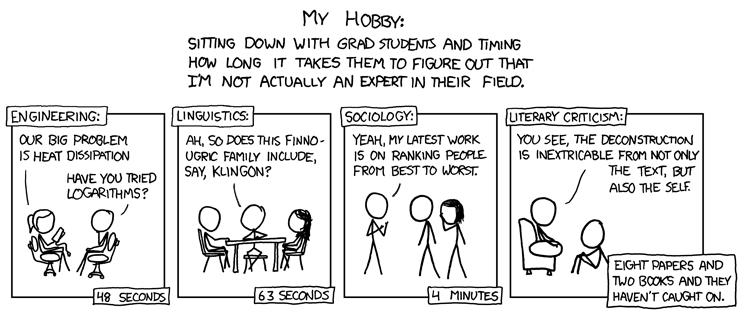
I really love the cartoon at the end. Just don't let any "soft majors" see it.
Post a Comment