http://docs.google.com/View?docid=dhtfdzv3_1f9x8jgjp
getting into subject...
Chapter 17
Thermal expansion and thermal stress
delta means changing
Linear expansion(1D):
delta L = alpha * Lo * delta T
@where L is length, Lo is the initial length and T for temperture
Volume(3D):
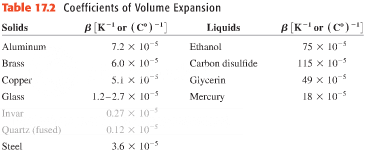
delta V = beta * Vo * delta T
@where V is volume, Vo is the initial volume and T for temperture
(there's also a equation for 2D....just change the V or L to A(area) and multiply alpha by 2)
here's the alpha and beta from the book....
Thermal conductivity
Q = (k*A*delta T) / L
@ where k = specific Heat, A = cross-section Area, T= temperture, L = length
so...how does this work...
since Q1 = Q2 (if, they conduct together)
so we can set up like....(taking Copper & Aluminum as example.....)
QCu = QAl
then, [400*A*(Tf - To)]/LCu = [240*A*(Tf - To)]/LAl
then we can find the common variable Tf
Phase Change
Temperature remains CONSTANT until change of phase is complete .remember this....very important....
Lf = Heat of Fusion
Lf => 80(cal/gram) = 3.35 x 10^5 (J/kg)
Lv= Heat of Evaoiration
Lv=> 540(cal/gram) = 2.26 x 10^6 (J/kg)
and remember!!!!!! Qgain + Qlost =0
example is in here....http://physics4b.blogspot.com/2008/09/third-daysighlong-weekend-no-more.html
Chapter 18
Ideal Gas Law
PV = nrT
for P=pressure(pa), V=vloume(m^3), n=# of moles(mol), r = 8.3145 , T=temperture
or
PV = NkBT
for P=pressure(pa), V=vloume(m^3), N=# of Atoms, kB = 1.38x 10^-23 , T=temperture
they are same equation....only different is dealing with mol or atom....differ by an Avocado's number....(i know...just think it as a typo)
oh......by the way.... 1 atm = 1.01 x 10^5 Pa....always convert it to Pa
Vrms = sqrt( [3*kB*T]/m )
@ where sqrt() = square root, kB = 1.38 * 10^-23, m = mass of gas(element) atom
or
Vrms = sqrt( [3*R*T]/M )
@ where sqrt() = square root, R= 8.314, M = molar mass of the gas(element)
Ktr = (3/2)*n*R*T
Heat Capacities
Cv = (3/2) * R (monatomic gas )
Cv = (5/2)* R (diatomis gas )
Cv = 3R (monatomic solid)
Chapter 19 & 20
General equation for all
Ein = Q - W
Ein = internal energy, Q=heat, W=work
isochoric
V = const
since there is no changing Volume, there W= P * delta V will just simply equal to 0.
and then the general will be:
Ein = (m*Cv* delta T ) - 0
therefore,
Ein = (m*Cv* delta T )
and we can use this equation for all thermodynamic process, as long as it's Ideal Gas.
(cuz Ein will not change...so this equation will apply everywhere)
isobaric
P = const
since P =const, there is both Q and W.
Q = m*Cp*delta T
W = P * delta V
apply them back to the general equation
Ein = Q - W ,we will get
Ein = m*Cp*delta T - P * delta V
furthermore, apply the Ein we got in the previous part we will get
(m*Cv* delta T ) = (m*Cp*delta T) - (P * delta V)
by this we can calculate everything......for isobaric
isothermal
T = const
since Ein = 0 , therefore
Q + W = 0
(reason why I dont do Q = W is because there will be a sign problem. is you do Q + W , then since one is positive and the other one is negative. we dont have to worry about sign. )
and W in isothermal is
Q = W = nRT * ln Vf / Vo
= P1V1 * ln Vf / Vo
Adiabatic
it means no heat
so, Ein = -W
W = n*Cv*(To -Tf) Note: yes, it's To - Tf(since it can be both release or absorb heat....well..u know what i'm trying to say...)
and for adiabatic....there's something more than this equation... sometimes we need to find P, or V, or T ourself.....in that case....we need to use these equations....
T1V1^(gamma - 1) = T2V2^(gamma-1)
P1V1^(gamma) = T2V2^(gamma)
Buoyang force
1st, buoyang force is a upward force that particle will excert by fluid(or gas).
cutting into subject, the hot balloon. we can simply draw a force diagram.
| FB
|
B
|
| mg
in which FB is the buoyang force upward, and mg is the weight downward.
in the general difinition, B= D * V* g .
B=buoyang force, D=density, V=volume and g = gravity
F = P/A, which also tells that P = FA. P=pressure, F=force, A=area
then we can get the presure excert by buoyang force is simply P = D*g*h (since V/A = height...)
so for the hot balloon, for it to float(upward force = downward force), the force FB = mg. then we can derive many more equation and so on....
oh...remember buoyang force is everywhere!!! even for the bottom of the hot balloon.
(end)

1 comment:
FIRST!! U N00B5 just got PWNED!!
Post a Comment